After more than six months of tension on the Polish–Belarusian border, the humanitarian and political crisis has not abated. Construction of the wall, which began on 25 January, marks yet another stage in the creation of divisions, barriers and unresolved fears of refugees.
These fears are compounded by long-standing anxieties about “strangers” – which often generate and reinforce stereotypical views, such as seeing migrants as potential terrorists trying to get into Poland, or as newcomers who will take away jobs and welfare benefits. The language used in media debates, often exaggerated on both sides, deepens misunderstanding and further radicalises public debate.
Can these fears and social divisions be addressed – and if so, how? How can we minimise the aggression they give rise to? Is an information campaign based on rational discourse enough? Or are there systemic solutions and proven good practices that could remedy the situation?
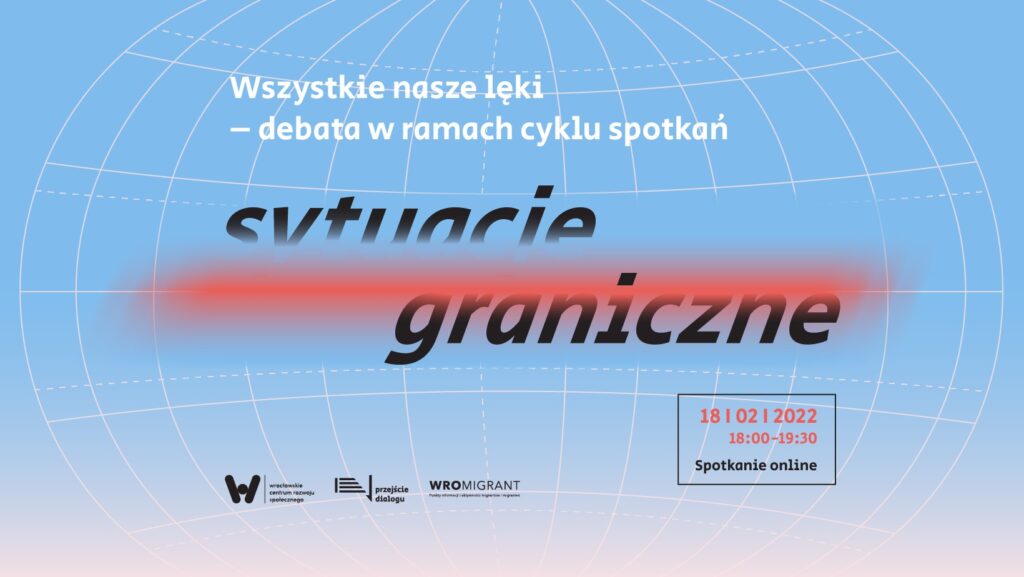
The debate will feature Michał Bilewicz, Dorota Hall and Dominika Blachnicka-Ciacek.
The discussion will be moderated by Daria Sudoł
The meeting will be held online: streamed live on the Passage of Dialogue Facebook page. Link to the event: www.facebook.com/events/1119351725545742
The meeting is part of the “Borderline Situations” (Sytuacje graniczne) project, initiated by Passage of Dialogue (Przejście Dialogu, Wrocław Centre for Social Development) and run in cooperation with Strefa Kultury Wrocław, the Lower Silesian Congress of Women, the “Mothers to the Border” (Matki na granicę) movement and other organisations working for refugees and migrants.
—
Michał Bilewicz – habilitated doctor of social sciences, associate professor at the University of Warsaw, social psychologist, sociologist and commentator. Head of the Center for Research on Prejudice at the University of Warsaw and lecturer at the university’s Faculty of Psychology.
Dorota Hall – habilitated doctor, cultural anthropologist and sociologist, professor at the Institute of Philosophy and Sociology of the Polish Academy of Sciences and president of the International Study of Religion in Eastern and Central Europe Association (ISORECEA). Her interests include minorities and social exclusion, particularly in the context of religion, gender and sexuality. Her most recent book is the monograph W poszukiwaniu miejsca. Chrześcijanie LGBT w Polsce (In Search of a Place: LGBT Christians in Poland, 2016). From 2009 to 2012 she served as the national expert in the European Commission’s Network of Socio-Economic Experts in the Non-Discrimination Field. She has also prepared research reports for the EU Agency for Fundamental Rights, covering topics including migration.
Dominika Blachnicka-Ciacek – sociologist who researches the relationship between space, memory and a sense of belonging among migrants and refugees in the cities of Europe and the Middle East. She completed her PhD in visual sociology at Goldsmiths College, University of London. She is currently an assistant professor at SWPS University and leads the Polish team of the project “Empowering Young Migrants in Vulnerable Situations through Fluid Integration” (funded by the European Commission).
Daria Sudoł – cultural critic, journalist, activist and feminist. A community educator, cultural animator and project coordinator who has worked in the non-governmental sector for many years, supporting the activation of local communities. She is involved in a number of socio-cultural initiatives and grassroots equality movements, and actively campaigns for excluded people, women’s causes, animal rights and the natural environment. President of the Fundacja Punkt Widzenia (Point of View Foundation). Curator of Dialogopolis.