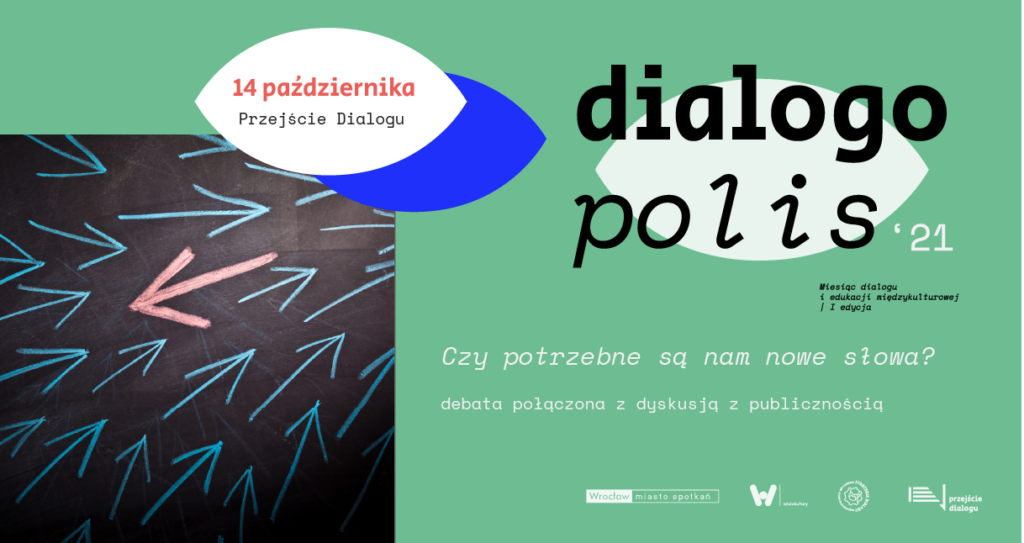
To its everyday users, the Polish language may seem entirely neutral – we are so used to the sound of words that we rarely stop to think about how they came about or the emotions they carry.
- Host: Joanna Synowiec
- Guests: Yulia Krivich, Jana Shostak, Dr hab. Tomasz Piekot, Bartłomiej Potocki, Bartłomiej Ciążyński
- Registration for attendance at Passage of Dialogue (Przejście Dialogu): https://bit.ly/CZYPOTREZBNE
- Format: debate followed by a discussion with the audience
- Who should come: anyone interested in the topic, especially people who work with young people
- Room capacity: 20
- The event will also be streamed live on Facebook
During the debate, we want to reflect together on what the Polish words for “foreigner” – “cudzo-ziemiec” (“someone from another’s land”) and “obco-krajowiec” (“someone from a strange country”) – actually express, and why Poles commonly say “na Ukrainie” (“on Ukraine”) rather than “w Ukrainie” (“in Ukraine”). Can we speak differently about those who are not from here, or about what is not ours – and if so, how and why? On the other hand, is the Polish language friendly to migrants? Can it be changed or simplified in a way that expresses solidarity, partnership, equality and the proverbial “Polish hospitality”?
- Jana Shostak – an artist born in Belarus who lives and works in Warsaw. She is a doctoral student at the University of the Arts in Poznań. Her practice focuses on activities that mobilise and “hack” communities beyond the art world.
- Yulia Krivich – a photographer and visual artist born in Ukraine who lives and works in Warsaw. Her work explores questions of identity, combining elements of activism with personal history.
- Dr hab. Tomasz Piekot – a linguist, co-founder of the Plain Polish Lab (Pracownia Prostej Polszczyzny) and a Polish language trainer. He works to simplify the way public institutions and offices communicate (https://piekot.pl).
- Bartłomiej Potocki – a lawyer, member of the Fundacja Ukraina team and head of the Migrant Rights Institute.
- Bartłomiej Ciążyński – a legal adviser, Deputy Chair of Wrocław City Council and the Mayor of Wrocław’s honorary adviser on tolerance and countering xenophobia.
- Joanna Synowiec – a curator, cultural animator, creator and member of the Nomada Association.
Dialogopolis is delivered as part of the ReSTART project, co-financed by the National Programme of the Asylum, Migration and Integration Fund (AMIF) and the state budget.