Photo: Maciek Jaźwiecki
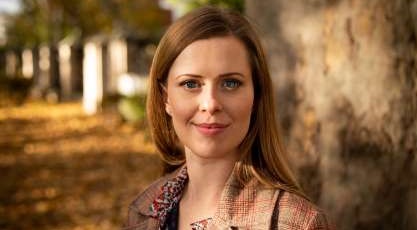
Next Wednesday (23 February) sees the launch of the Jewish Book Club at Passage of Dialogue (Przejście Dialogu). We will meet on the last Wednesday of every month to talk about Israeli literature and more. We asked the club’s founder and organiser, Ula Rybicka, a few questions to find out more about the project.
PD: Where did the idea for the Jewish Book Club come from? Who is the club for?
UR: For several years I have been promoting Jewish literature, mainly online. I know it’s a subject that interests a lot of people. I run Żydoteka – social media profiles where you can find book reviews and information about writers and the literary world. A large community of people who, like me, love the prose of Jewish authors has grown up around Żydoteka. I wanted to offer them something more, hence the idea of Club meetings. I think talking to people who share your interests is enjoyable and stimulating, and it can also break up the daily routine. The Club is for all book lovers, as well as anyone who would like to get to know Jewish culture.
PD: What kind of journey are you taking us on? Will it be a journey back in time – to the pre-war years, for example – or a journey in the geographical sense?
UR: I want to showcase the richness of Jewish literature as broadly as possible – to show how many subjects it covers and in how many different ways. I think that way a lot of people can find something in it for themselves, whether that’s history books or comics, novels or reportage. At the first meetings I would particularly like to introduce writers from Israel, as that is the literature closest to my heart. I’m not alone in that, though – writers such as Etgar Keret and Amos Oz have thousands of admirers in Poland.
PD: Who chooses the books? Are there any titles lined up yet? What will you start with?
UR: The first meeting in February will be the Club’s launch, a chance for us to get to know each other and talk in general about our favourite Jewish books and authors. After that, the meetings will work like a typical book club – we will discuss one chosen book and its author. I can’t reveal the exact titles just yet, but I can promise that we will be reading truly excellent works by leading writers. Some of the books will probably already be familiar to Club members, but perhaps thanks to our meetings someone will discover a fantastic writer and a whole new literary world!
PD: Literature allows us to immerse ourselves in the situation of the main character, taking in a range of factors, including cultural context and nuance. Do you think these threads will come up naturally in discussion, or do you plan to encourage members to look at them?
UR: I’m open to different interpretations. Everyone reads a little differently, through the lens of their own knowledge, experience and sensibility. That’s what makes talking about literature so interesting – you get to hear different points of view, not just the author’s. Some books are brimming with the nuances of Jewish culture; others are universal, and the protagonist could just as well be set in a different cultural context. I believe that by letting us follow characters’ lives, books teach us empathy and understanding for others. I think that’s what matters most to me when I read.
PD: What about getting hold of the books? Will members be able to borrow them from you?
UR: We will only discuss books that are easy to get hold of. You can buy them in print or as e-books, or borrow them from the Municipal Public Library. The next book will be announced about a month in advance, so that everyone has time to get a copy and read it at leisure. Reading in the comfort of your own home is also part of the idea behind the Club.
PD: Why did you choose Passage of Dialogue as the venue rather than, say, a place directly involved in promoting Jewish culture in Wrocław?
UR: Above all because the idea behind Passage of Dialogue fits perfectly with the idea of the Book Club. I want our meetings to be open to dialogue, to getting to know one another and to talking about other cultures. It matters to me that everyone feels comfortable at the meetings and can learn something about Jewish culture. I think it’s important for these topics to be present in all kinds of places – not only Jewish ones. I realise that some people might feel intimidated about going to a synagogue for a meeting like this. That’s why I’m very glad that Passage of Dialogue is open to initiatives like ours.
PD: Thank you for the interview – we can’t wait for the first meeting with fellow book lovers!
If you are interested in the Jewish Book Club, visit the event page: https://fb.me/e/2RYk0cpCg
And don’t forget to visit the official website of the “Żydowski Wrocław” (Jewish Wrocław) project, which will take you on a unique journey around our city: Żydowski Wrocław – (zydowskiwroclaw.pl)