For many years, Wrocław and Lower Silesia have prided themselves on their multiculturalism – whether as a legend the region’s inhabitants needed to come to terms with its German past, as good marketing by the regional authorities, or for other reasons altogether. The growing interest in the subject in recent years is also reflected in the many academic works and novels inspired by this phenomenon that can now be found in bookshops.
ㅤ
For more than fifteen years, Kalejdoskop Kultur has worked alongside Wrocław’s national and ethnic minority groups, which are an inseparable part of the community of our city and region. Today, we want to look at the challenges, opportunities and threats that minorities face in the light of the cultural changes we have seen in recent years.
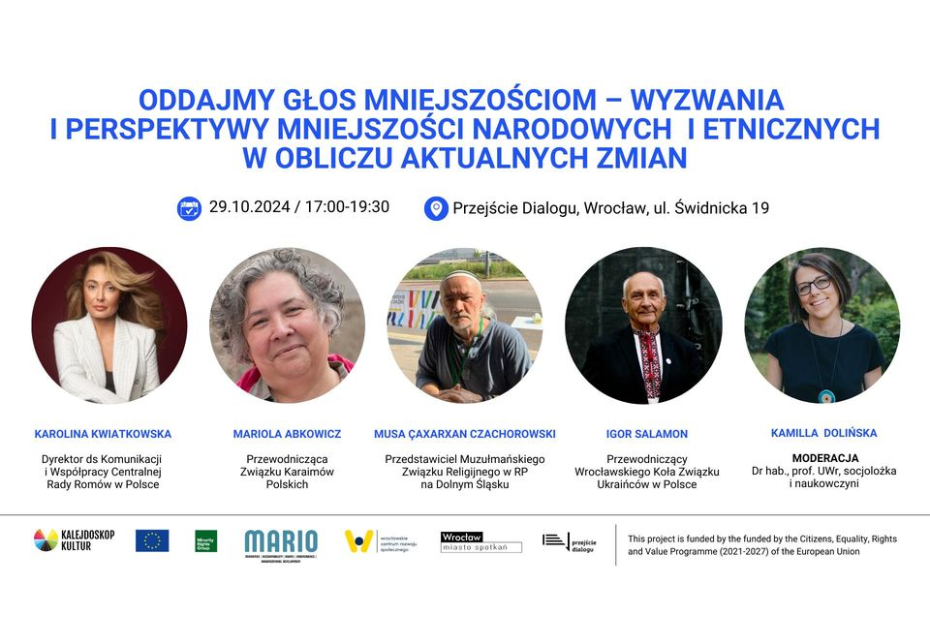
The following leaders of national and ethnic minority organisations have been invited to take part in the discussion:ㅤ
– Mariola Abkowicz, Chair of the Union of Polish Karaims;
– Karolina Stankiewicz-Kwiatkowska, Director of Communications and Cooperation at the Central Council of Roma in Poland;
– Musa Czachorowski, representative of the Muslim Religious Union in the Republic of Poland for Lower Silesia;
– Ihor Salomon, Chair of the Wrocław Branch of the Union of Ukrainians in Poland.
ㅤ
Moderator: Dr hab. Kamilla Dolińska, Professor at the University of Wrocław, sociologist and researcher.
ㅤ
“Let’s give minorities a voice – challenges and prospects for national and ethnic minorities in the face of current cultural change”
When? 29 October, 17:00-19:30
Where? Passage of Dialogue (Przejście Dialogu), Wrocław, ul. Świdnicka 19
Registration! As places are limited, please register your interest in attending the debate by e-mail at: info@kalejdoskopkultur.pl.
ㅤ
The meeting is part of the MARIO project, funded by the European Union’s “Citizens, Equality, Rights and Values” programme (2021-2027)
More about the speakers
Kamilla Dolińska – Dr hab., Professor at the Institute of Sociology, University of Wrocław. A sociologist working in the Department of Borderland Sociology at the Institute of Sociology, University of Wrocław, and a member of the Centre for Regional and Borderland Studies. Her research interests focus on borders and borderlands, multiculturalism, migration and issues relating to national and ethnic minorities. Co-editor (with Sławomir Łodziński) of the book Mobilizacja etniczności. Mniejszościowe społeczności narodowe i etniczne w spisie powszechnym ludności i mieszkań w Polsce (The Mobilisation of Ethnicity: National and Ethnic Minority Communities in the Polish Population and Housing Census), Warsaw, Scholar, 2024.
Musa Çaxarxan Czachorowski – journalist, poet, translator and publisher. Press spokesperson for the Muslim Religious Union in the Republic of Poland and its representative for Lower Silesia. Editor-in-chief of the quarterly «Przegląd Tatarski». Author of over a dozen poetry collections, translations of Tatar fairy tales and numerous publications on Tatar and Muslim themes, including a translation of the Qur’an (three Polish editions: 2018, 2020, 2021; two Turkish editions: 2022). His work has appeared in journals including «Akcent», «Format Literacki», «Kultura», «Odra», «Poezja», «Prowincja», «Şəfəq» (Azerbaijan), «Bajram» (Belarus), «Lietuvos totoriai» (Lithuania), «AlTaBaş» (Germany), «Idel» (Tatarstan), «Mädäni comğa» (Tatarstan), «Qazan utları» (Tatarstan), «Tatar dönyası» (Tatarstan), «Мäydan» (Tatarstan), «Magyar Napló» (Hungary) and «Vár Ucca Műhely» (Hungary). His work has been translated into Azerbaijani, Arabic, Croatian, Russian, Tatar, Turkish and Hungarian.
Mariola Abkowicz – librarian, academic teacher and community activist. A graduate of Adam Mickiewicz University in Poznań, she teaches at the Institute of Oriental Studies and the Department of Language Policy and Minority Studies. She is actively involved in promoting Karaim culture and heritage. She is Chair of the Board of the Union of Polish Karaims, a board member of the Karaim Heritage Foundation and Chair of the Council of the Kalejdoskop Kultur Foundation. Since 2003, she has coordinated or supervised projects run by the Union of Polish Karaims, securing grants from public sources. She is the publisher and editor-in-chief of the Karaim historical, social and cultural quarterly «Awazymyz», the «Karaim Almanac», e-Jazyszlar – the Karaim Digital Archive, the «Bitik» publishing house of the Union of Polish Karaims and the website www.karaimi.org. For her community work on behalf of the Karaim community and minority groups, she has been awarded the Gold Cross of Merit, the Gold Badge of the Society of Friends of Wrocław and the «Merito de Wratislavia – Distinguished Service to Wrocław» medal. As a representative of the Karaim community, she takes part in the work of the Joint Commission of the Government and National and Ethnic Minorities and of the Kalejdoskop Kultur Agreement of representatives of national and ethnic minorities.
Karolina Kwiatkowska – Director of Communications and Cooperation. She has worked for the Roma community for more than 20 years. A cultural studies graduate, journalist and anti-discrimination trainer, she studied at the University of Białystok. She engages in social, political and legal advocacy and implements solutions in education and intercultural dialogue. She acts as a consultant to the state administration, local governments and international organisations. She led consultations on the Act on National and Ethnic Minorities and on the Regional Language, and served on the team for Roma affairs at the Ministry of the Interior and Administration. She prepared recommendations for the Joint Commission for National and Ethnic Minorities and for EU programmes aimed at people at risk of social exclusion. She was consulted on the legislation establishing 2 August as the Roma Genocide Remembrance Day. She was an education expert and press spokesperson for the European Roma and Travellers Forum, affiliated with the Council of Europe. She has co-authored numerous studies on Roma children in the Polish education system and on Roma in the labour market, and co-created an educational programme to build the competences of Roma Education Assistants. She is an education expert at the International Romani Union.
Ihor Salamon — Chair of the Wrocław Branch of the Union of Ukrainians in Poland (ZUwP).