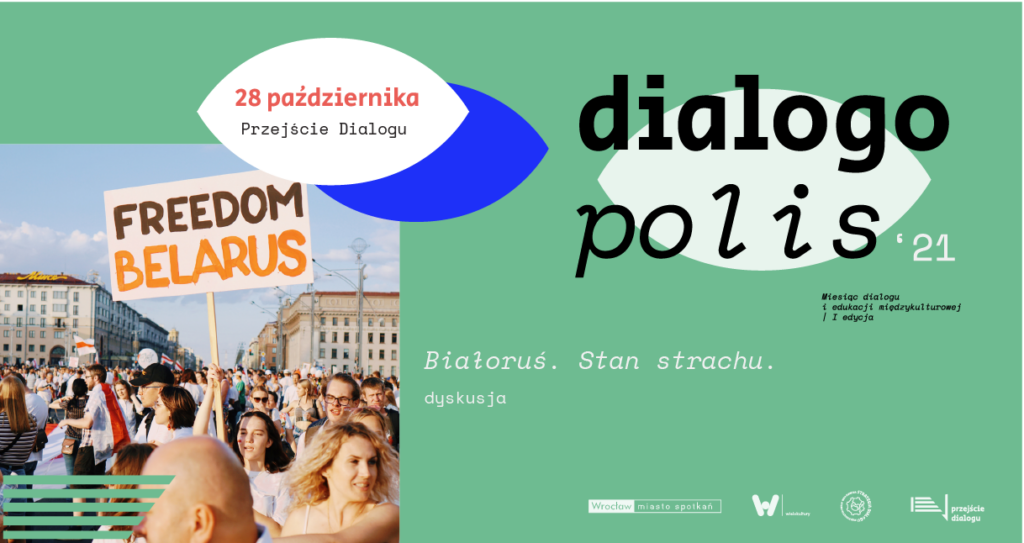
Never since Alexander Lukashenko came to power have there been protests and repression on the scale we have been witnessing in Belarus for more than a year now. Often called “Europe’s last dictator”, he has held power since 1994. After he rigged the 2020 election, mass protests swept the country. Many opposition figures have been jailed, and thousands of citizens have already faced arrests, beatings, night-time searches, sudden detentions and many other forms of repression.
As a result, more and more people are choosing to flee their country. What chance do protesters have today? Is there still any point in protesting in Belarus at all? The subject of Belarus barely features in the Polish media any more, while Belarusians living in Poland are doing everything they can to keep the cause of their freedom in the eyes of the world. We will discuss all of this with our guests at a meeting held as part of GLOBAL WRO – Press Review from Wrocław.
Host: Piotr Kaszuwara
Guests: Tatiana Iwanow, Franek Osławski, Tomasz Wiliński, Witold Dobrowolski.
Registration: http://kalejdoskopkultur.pl/?p=4648
Format: discussion
Who should come: anyone interested in the topic
Room capacity: 20
Live stream on Facebook
Guests: Tatiana Iwanow, Franek Osławski, Tomasz Wiliński, Witold Dobrowolski.
Registration: http://kalejdoskopkultur.pl/?p=4648
Format: discussion
Who should come: anyone interested in the topic
Room capacity: 20
Live stream on Facebook
Tatiana Iwanow – a long-standing campaigner for the Belarusian minority in Wrocław, a doctoral student at the University of Wrocław and a Lane Kirkland Scholarship holder. She has 15 years’ experience of supporting the Belarusian minority in Wrocław as an activist with the “For Your Freedom and Ours” Foundation. After the rigged 2020 election in Belarus, she began working to support migrants. She has delivered many projects, including the Festival of Independent Belarusian Culture (2010–2021) and the Natalya Gorbanevskaya Remembrance Days (2014–2016).
Franek Osławski – a Belarusian activist who has lived in Wrocław for more than 20 years. He is one of the main organisers of the Belarusian protests that have been held in Wrocław since the very beginning of the revolution across Poland’s eastern border. Known as “Wrocław’s Nina Bagińska”, he has not missed a single rally for Belarus organised in the city, and is usually seen with the white-red-white Belarusian flag draped over his shoulders.
Tomasz Wiliński – a human rights defender, specialist in international criminal law and an advocate. Since the 2020 presidential election in Belarus, he has been actively supporting people persecuted by Alexander Lukashenko’s regime, including Poles and Belarusians. He represented three Poles who were detained and tortured in August 2020, and works with Sviatlana Tsikhanouskaya’s office, the Belarusian National Anti-Crisis Management and the Belarusian Solidarity Centre. He brought about the first investigation in Europe into deprivation of liberty with particular cruelty and the use of torture by the Belarusian regime.
Witold Dobrowolski – a reporter and war correspondent, including in Donbas in eastern Ukraine. A writer and journalist, he won the Grand Press Photo 2020 award for his photographs of the 2019 student protests in Hong Kong. He is the author of books including “Ruch Azowski. Ideologia, działalność i walka ukraińskich nacjonalistów” (The Azov Movement: The Ideology, Activities and Struggle of Ukrainian Nationalists). Witold Dobrowolski was one of the Poles detained in Belarus during the first wave of protests.
Piotr Kaszuwara – a journalist. For 20 years he has contributed to many Polish media outlets, including Onet.pl, Polsat News, Polish Radio’s Programme Three, Radio Wrocław and Money.pl. Founder and editor-in-chief of the www.KolorowePtaki.com. portal. Lecturer at the Institute of Journalism of the University of Wrocław, war correspondent in Donbas in eastern Ukraine, and one of the few Western journalists to have visited the so-called Donetsk People’s Republic. He has also reported as a war correspondent from Georgia, Nagorno-Karabakh and the West Bank, and works as an investigative journalist, reporter and documentary film-maker.
Dialogopolis is delivered as part of the ReSTART project, co-financed by the National Programme of the Asylum, Migration and Integration Fund (AMIF) and the state budget.