Which events had a decisive influence on the shaping of modern Belarus? What did the proclamation of the Belarusian People’s Republic in 1918 mean? What traces of Belarusian history and tradition can we find in today’s literature and culture?
(Belarusian version below // беларуская версія ніжэй)
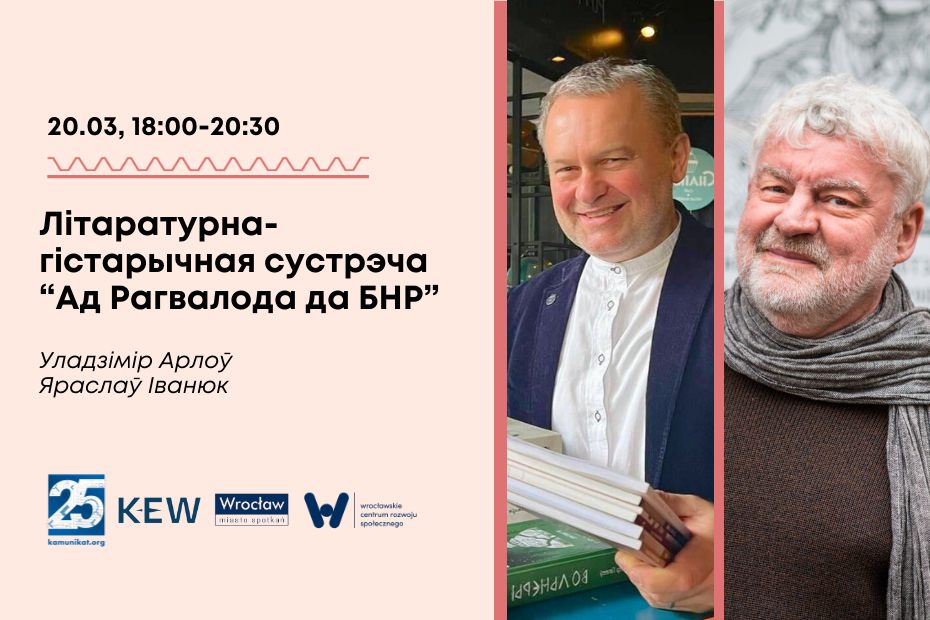
On 20 March 2025, Wrocław will host a special meeting that will let us explore these questions. Our guest will be one of the most distinguished contemporary Belarusian writers, Uladzimir Arlou, who will take us on a journey through the history of Belarusian statehood. He will talk about the beginnings of Belarus in the 10th century, when Prince Rogvolod arrived in Polotsk. His story shows how Belarusian aspirations to independence were fulfilled in 1918, when the independence of the Belarusian People’s Republic was declared. Although this statehood did not last long, it remains a point of reference to this day for Belarusians who believe in the ideals of freedom. It is also worth noting that 25 March, the anniversary of the proclamation of the Belarusian People’s Republic, is banned by the Lukashenko regime, yet Belarusians all over the world mark the day as Freedom Day, celebrating under the white-red-white colours.
Our second guest will be Jarosław Iwaniuk – a journalist and the founder of the world’s largest Belarusian Internet Library, Kamunikat.org, whose collection currently includes more than 65,000 Belarusian publications (books, audiobooks, newspapers, magazines, audio and video materials). Jarosław Iwaniuk will talk about how the idea for the library came about – this year it celebrates its 25th anniversary. Today Kamunikat.org is also a foundation with a busy publishing programme: in less than four years it has published more than 100 books and audiobooks.
After the talk there will be time for discussion with the guests, and books will be available to buy.
When? 20 March 2025, 18:00
Where? Passage of Dialogue (Przejście Dialogu), ul. Świdnicka 19 (Świdnicka underpass)
Language: Belarusian
Admission free!
Organisers: Kamunikat.org Foundation, the Jan Nowak-Jeziorański College of Eastern Europe, the Belarusian Solidarity Union Association, Wrocław Centre for Social Development (WCRS)
Якія падзеі аказалі ключавы ўплыў на фармаванне сучаснай Беларусі? Што азначала абвяшчэнне Беларускай Народнай Рэспублікі ў 1918 годзе? Якія сляды беларускай гісторыі і традыцый можна знайсці ў сённяшняй літаратуры і культуры?
20 сакавіка 2025 года ў Вроцлаве адбудзецца ўнікальная сустрэча, якая дапаможа нам разгледзець гэтыя пытанні. Гасцямі мерапрыемства стануць адзін з самых выдатных сучасных беларускіх пісьменнікаў Уладзімір Арлоў, які возьме нас у падарожжа па гісторыі беларускай дзяржаўнасці. Ён раскажа пра пачаткі Беларусі, якія адносяцца да X стагоддзя, калі ў Полацк прыехаў князь Рагвалод. Яго гісторыя паказвае, як беларускія імкненні да незалежнасці ажыццявіліся ў 1918 годзе, калі была абвешчана незалежнасць Беларускай Народнай Рэспублікі. Нягледзячы на тое, што гэтая дзяржаўнасць не пражыла доўга, да яе сёння звяртаюцца тыя беларусы, якія веряць у ідэі свабоды. Таксама варта адзначыць, што 25 сакавіка, гадавіна абвяшчэння БНР, забаронена рэжымам Лукашэнкі, але беларусы па ўсім свеце адзначаюць гэты дзень як Дзень Волі, святкуючы пад бела-чырвона-белымі колерамі.
Другім госцем будзе Яраслаў Іванюк — журналіст і заснавальнік найбуйнейшай у свеце Беларускай Інтэрнэт-бібліятэкі Kamunikat.org, у рэсурсах якой зараз знаходзіцца больш за 65 тысяч беларускіх публікацый (кнігі, аўдыякнігі, газеты, часопісы, аўдыё і відэаматэрыялы). Яраслаў Іванюк раскажа пра тое, як узнікла ідэя бібліятэкі, якая ў гэтым годзе адзначае юбілей 25-годдзя. Сёння Kamunikat.org таксама з’яўляецца фондамі, які вядзе багатую выдавецкую дзейнасць — за менш чым чатыры гады было выдадзена больш за 100 кніг і аўдыякніг.
Пасля сустрэчы будзе час на дыскусію з гасцямі і магчымасць набыць кнігі.
Калі? 20 сакавіка 2025 года, у 18:00
Дзе? у Пераходзе Дыялогу, вул. Свідніцкая 19 (пераход Свідніцкі)
Мова: беларуская
Уваход свабодны!
Арганізатары: Fundacja Kamunikat.org, Kolegium Europy Wschodniej im. Jana Nowaka-Jeziorańskiego, Stowarzyszenie Białoruski Związek Solidarności, Wrocławskie Centrum Rozwoju Społecznego